
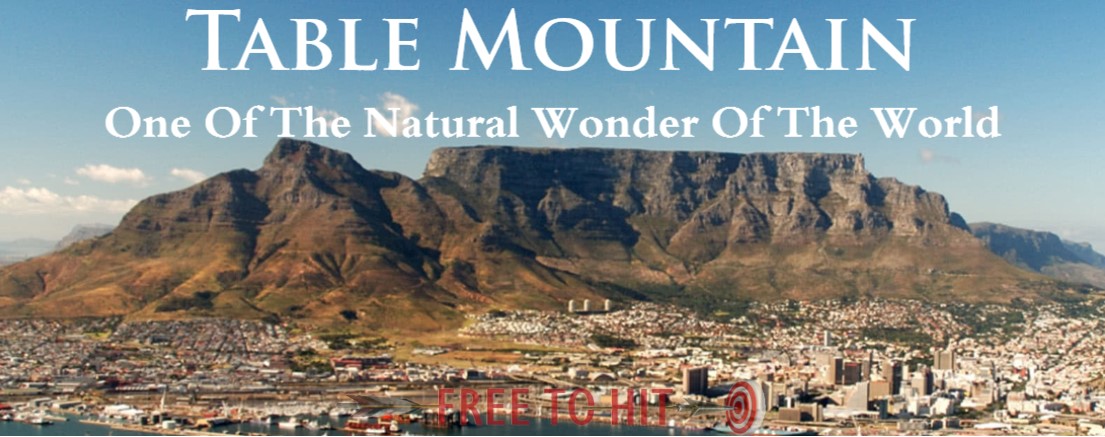
We all know the shape of mountains which is look like a pyramid or a cone but there is a mountain in Cape Town, South Africa which has flat topped, known as Table Mountain. The mountain forms part of the Table Mountain National Park and the height of Table Mountain is 1085 metres. Table Mountain is one of the natural wonder of the world. The level of plateau of the Table Mountain is approximately 3 km (2 mi) from side to side. Two subsidiary peaks are detached from the main mountain: Lion’s Head 2,195 feet (669 metres) to the northwest, declining northward to Signal Hill (Lion’s Rump); and Devil’s Peak 3,281 feet (1000 metres) to the northeast (formerly Windberg or Windy Mountain). To the west, along the Atlantic coast, Table Mountain is framed by a series of peaks referred to as the Twelve Apostles. The highest point on Table Mountain is towards the eastern end of the plateau.
The original name for Table Mountain was “Hoerikwaggo”, meaning “Mountain in the Sea”, given to it by the Khoekhoen. The Khoekhoen was the traditionally nomadic pastoralist indigenous population of southwestern Africa. They were grouped with the hunter-gatherer San peoples. This later changed in 1503, when Portuguese explorer Antonio de Saldanha hiked the mountain (the first recorded hike in history) and renamed it Tabao de Cabo (“Table of the Cape”). The great cross that the Portuguese navigator carved into the rock of Lion’s Head is still traceable. Again the name changed in 1652, when Dutch settlers started referring to the mountain as Tafelberg.
Table Mountain is approximately 250 million years old. It is the northernmost end of a 50 km long (30 mi) and roughly six-to-ten-km wide (4 to 6 mi) Cape Fold Mountain range. In 1796 during the British occupation of the Cape, Major-General Sir James Craig ordered to be built three blockhouses on Table Mountain: the King’s Blockhouse, Duke of York Blockhouse (later renamed Queen’s Blockhouse) and the Prince of Wales Blockhouse. Two of these are in ruins today, but the King’s Blockhouse is still in good condition and easily accessible from the Rhodes Memorial. Between 1896 and 1907, five dams were opened on the back table to supply Cape Town’s water needs; the Woodhead Dam, Hely-Hutchinson Dam, De Villiers Dam, Alexandria Dam and Victoria reservoirs Dam. There is a well-preserved steam locomotive from this period housed in the Waterworks Museum at the top of the mountain near the Hely-Hutchinson dam.
To the south of Table Mountain is a rugged plateau at a somewhat lower elevation at about 1,000 m (3,300 ft) called the “Back Table”. Table Mountain and the Back Table have an unusually rich biodiversity. Table Mountain’s vegetation types form part of the Cape Floral Region protected areas. These protected areas are a World Heritage Site, and an estimated 2,285 species of plants are confined to Table Mountain and the Cape Peninsula range. Table Mountain is also home to porcupines, mongooses, snakes, lizards, tortoises, and a rare endemic species of amphibian that is only found on Table Mountain, the Table Mountain ghost frog. Up until the late 1990s, baboons occurred on all the mountains of the Peninsula, including the Back Table. Since then they have abandoned Table Mountain and the Back Table, and only occur south of Constantia Nek.
From the Southern Suburbs side, the Nursery Ravine and Skeleton Gorge routes start at Kirstenbosch National Botanical Garden. Kirstenbosch is an important botanical garden nestled at the eastern foot of Table Mountain in Cape Town. The garden is one of ten National Botanical Gardens covering five of South Africa’s six different biomes and administered by the South African National Biodiversity Institute (SANBI). Prior to 1 September 2004, the institute was known as the National Botanical Institute.
The Table Mountain Aerial Cableway is a cable car transportation system offering visitors a five-minute ride to the top of Table Mountain in Cape Town. The original construction was awarded in 1926 to the former world-renowned cable way company Adolf Bleichert & Co. of Leipzig, Germany. They took more than two years to build the Table Mountain Aerial Cableway and officially this transport system was open on October 4, 1929. After that the Table Mountain Aerial Cableway has been refurbished three times. The first refurbishment occurred in 1958, the second in 1974, whereas the third, latest and most important reconstruction has been started in 1996, which began operation in 1997 and included a “Rotair” panorama gondola manufactured by the Swiss company Garaventa AG – CWA (Doppelmayr Garaventa Group). After this reconstruction, the capacity of passenger increases from 20 up to 65 and now visitor can take a panoramic view over the city as this cable car rotate through 360 degrees during the ascent or descent. Approximately one million people a year using the Cableway. In January 2019, the Cableway welcomed its 28 millionth visitor.
The Table Mountain Aerial Cableway takes passengers from the lower cable station on Tafelberg Road, about 302 metres (991 ft) above sea level. The upper cable station is on the westernmost end of the Table Mountain plateau, at an elevation of 1,067 metres (3,501 ft). The upper cable station offers views over Cape Town, Table Bay, Lion’s Head and Robben Island to the north, and the Atlantic seaboard to the west and south.
Hiking on Table Mountain is popular amongst locals and tourists, and a number of trails of varying difficulty are available. On an average it takes about 2.5 hours. There are well-documented climbing routes of varying degrees of difficulty up the many faces of the mountain. The main climbs are located on cliffs below the upper cable station. No bolting can be done here and only traditional climbing is allowed. Commercial groups also offer abseiling from the upper cable station. The slopes of Table Mountain have many jeep tracks that allow mountain biking. The route to the Block House is a popular route for bike riding. Plum Pudding Hill is the name of a very steep jeep track. Bike riders should follow the directional signs on display for mountain bike riders.
Fires are common on the mountain due to hot climate. A big fire in 1986, the Cape Peninsula Protected Natural Environment (CPPNE) area was established in 1989. Following another big fire in 1991 and again in 2006 fire was a large fire in and around the Table Mountain National Park in Cape Town. It broke out at approximately 4 p.m. on 26 January 2006 above Tafelberg Road, and spread quickly due to dry conditions and strong winds.
On 29 May 1998, then-president Nelson Mandela proclaimed the Cape Peninsula National Park. The park was later renamed to the Table Mountain National Park. In November 2011, Table Mountain was named one of the New7Wonders of Nature. Table Mountain is one of the most awe-inspiring and iconic attractions. Thousands of tourists are coming every year. The Table Mountain is one of the best tourist destinations in South Africa.
Free To Hit is author of this blog and you can read this blog at Table Mountain: One Of The Natural Wonder Of The World
 Free To Hit